Eucalyptus vs Tea Tree: How Do the Two Differ?
Eucalyptus and tea tree are both sharp, green, very Australian leaf oils, and they often sit on the same shelf, so it is easy to treat them as two versions of one thing. They are not. The neatest way to see it is in how each oil is specified: eucalyptus oil is judged on a minimum amount of a compound called 1,8-cineole, and tea tree oil is judged partly on a maximum of the very same compound.
Eucalyptus Essential Oil
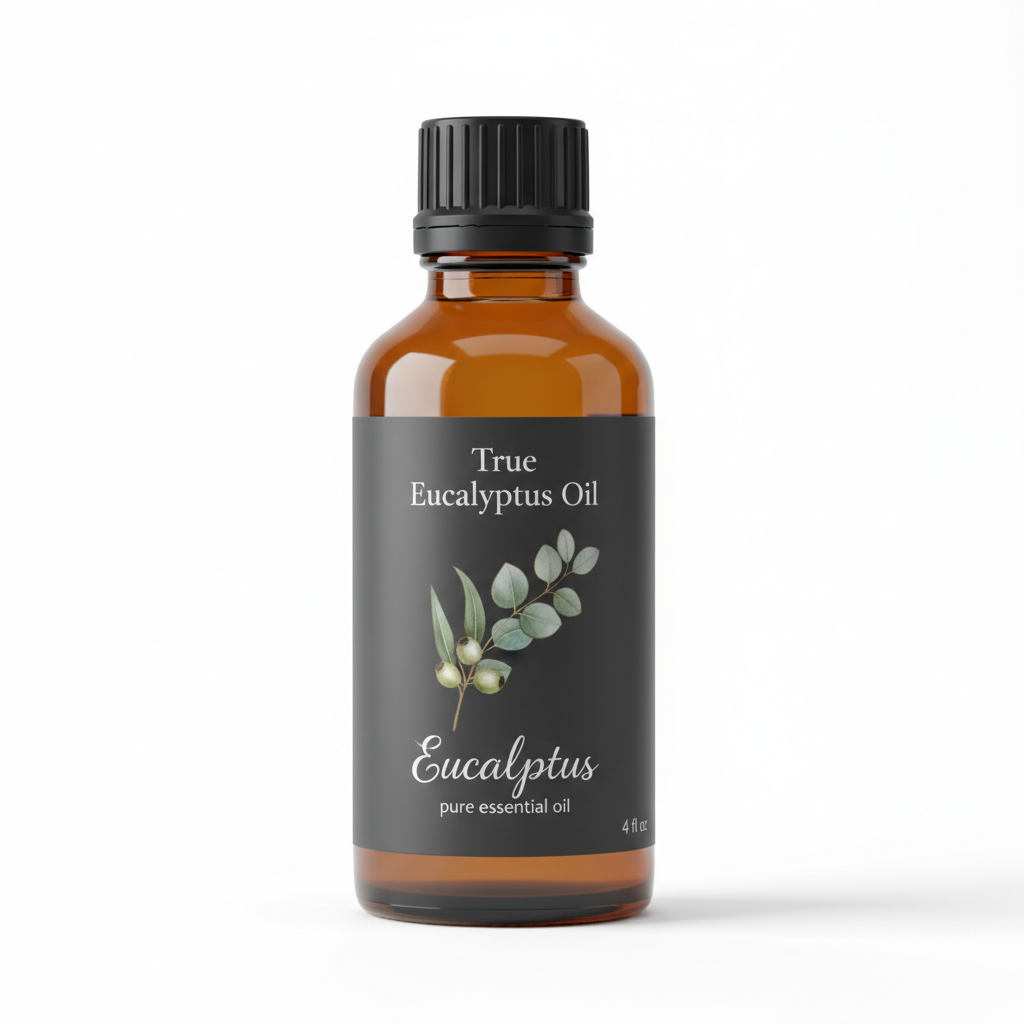
Our own Eucalyptus Essential Oil, in sizes from 0.5 oz to bulk.
From $9.99
Shop Now →Two standards, mirror images
A 1992 review for the UK Natural Resources Institute says the general norm for cineole-rich eucalyptus oil, set by the international standard for Eucalyptus globulus oil and the British Pharmacopoeia, is a minimum of 70% cineole (Eucalyptus oils: a review of production and markets (NRI Bulletin 56)). Tea tree sits the other way round. A 2006 review tabulating ISO 4730 lists terpinen-4-ol at a minimum of 30% and 1,8-cineole at a maximum of 15%. Its example of a typical tea tree oil has 40.1% terpinen-4-ol and only 5.1% cineole. The authors add that the reason for capping cineole in tea tree "may not have been entirely sound," since cineole's old reputation as a skin irritant rested on anecdote (Melaleuca alternifolia (Tea Tree) Oil: a Review of Antimicrobial and Other Medicinal Properties).
That is our favorite way to explain the difference. For eucalyptus, cineole is the point of the oil. For tea tree it is something the standard keeps small. We do not think of either as a stand-in for the other, and that is our position rather than a rule in any book.
Eucalyptus is a family, tea tree is one tree
Tea tree oil in that review comes from a single species, Melaleuca alternifolia. Eucalyptus is a whole genus, and the species you choose changes the oil a great deal. The same trade review shows cineole in crude oils ranging from about 60 to 65% for globulus grown in Portugal and Spain to about 70 to 75% for smithii from southern Africa and 80 to 85% for Australian polybractea. Lemon eucalyptus is different again, built mainly on citronellal rather than cineole.

We sell five eucalyptus oils from five species: globulus, radiata, lemon eucalyptus, smithii and dives. We do not list a cineole figure for any of them, so we will not claim a comparison with a tea tree specification. If a figure matters for your formula, ask us in writing before you order and get the answer in writing. For a tour of the five, see Globulus, Radiata, Citriodora.
How they smell side by side
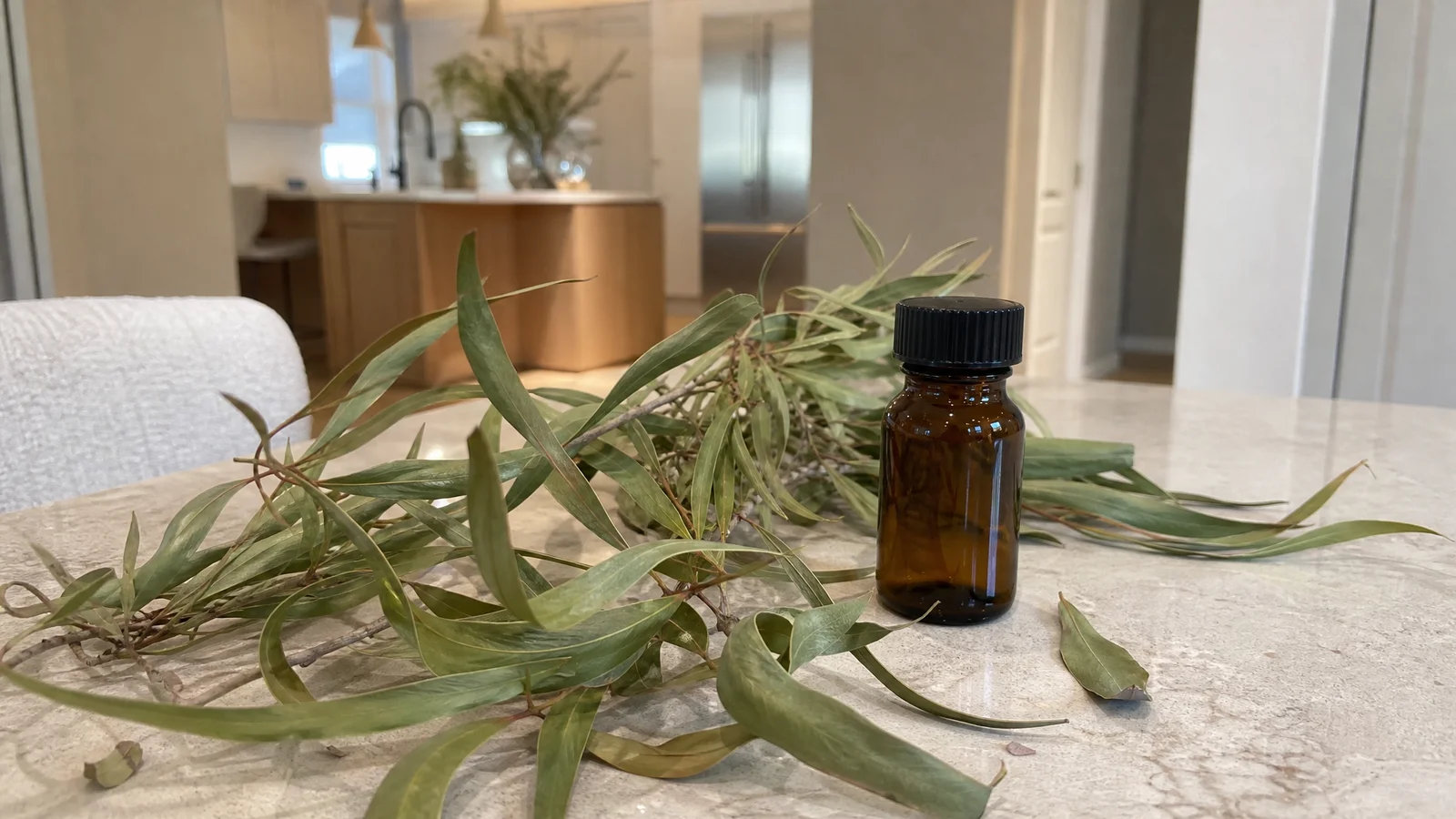
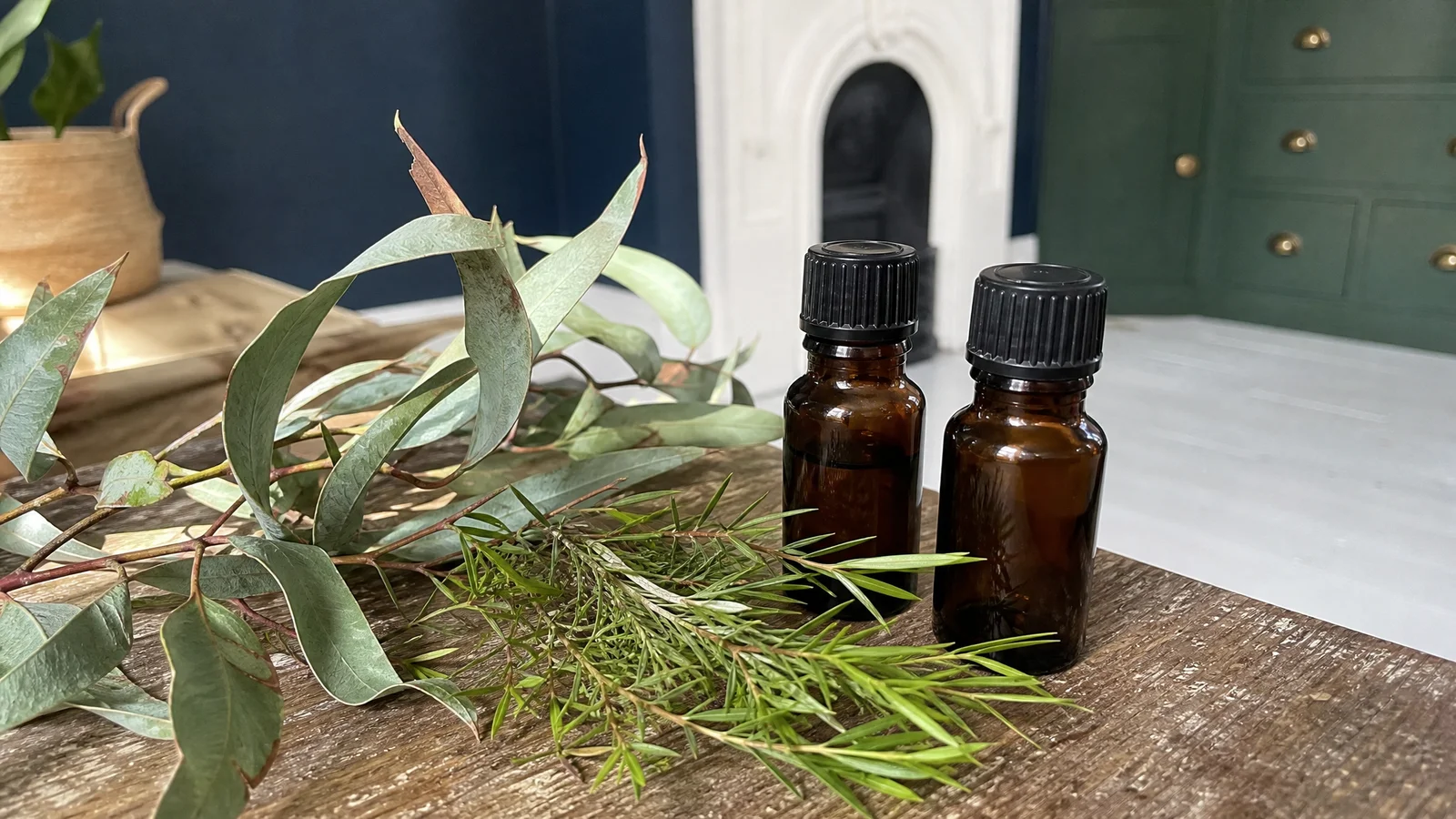
Put the two bottles next to each other and the difference in character is clear even before you read a label. Eucalyptus, depending on the species, is cool and clean, soft and sweet or bright and lemony. Tea tree has a sharper, earthy-herbal smell that many people either love or find a little much. If you like a spa-like, airy room, eucalyptus tends to be the friendlier of the two. If you prefer a deeper, greener smell, you may reach for the other.
Fresh oil matters for both
One thing the two oils share is that they like to be kept well. The tea tree review reports that allergic reactions described with tea tree oil seem to be caused mainly by oxidation products in aged or poorly stored oil, and that light, heat, air and moisture all affect stability. We are not suggesting the same finding for eucalyptus, but the storage advice is sensible for any essential oil: keep the cap snug and the bottle somewhere cool and out of the light. We say eucalyptus oils typically keep two to three years when stored that way. Our guide to shelf life and storage goes into detail.
Households with little ones and pets
Here the oils have something in common. The ASPCA lists eucalyptus as toxic to dogs, cats and horses, naming eucalyptol as the toxic principle and salivation, vomiting, diarrhea, depression and weakness as signs (Toxic and Non-toxic Plants: Eucalyptus). Our reading is that neither oil belongs on or around an animal without a veterinarian's say-so. Our cat and dog articles go further.
For children, we advise that high-cineole oils are not appropriate for babies and young children and should not go on or near an infant's face. Both oils belong out of reach and are for external aroma use only; if anyone swallows either, call Poison Help at 1-800-222-1222 or your local poison centre. A pediatrician is the right person to ask about anything more.
Where the research on each oil lives
Tea tree has a large body of laboratory and clinical literature, and the 2006 review is a good place to read about it. We leave those findings where they belong, in the literature, and we make no antibacterial, respiratory, repellent or medical claim for our eucalyptus oils. If you are curious about the questions people ask, Is Eucalyptus Oil Antibacterial? looks at them with sources.
A practical note on shelves
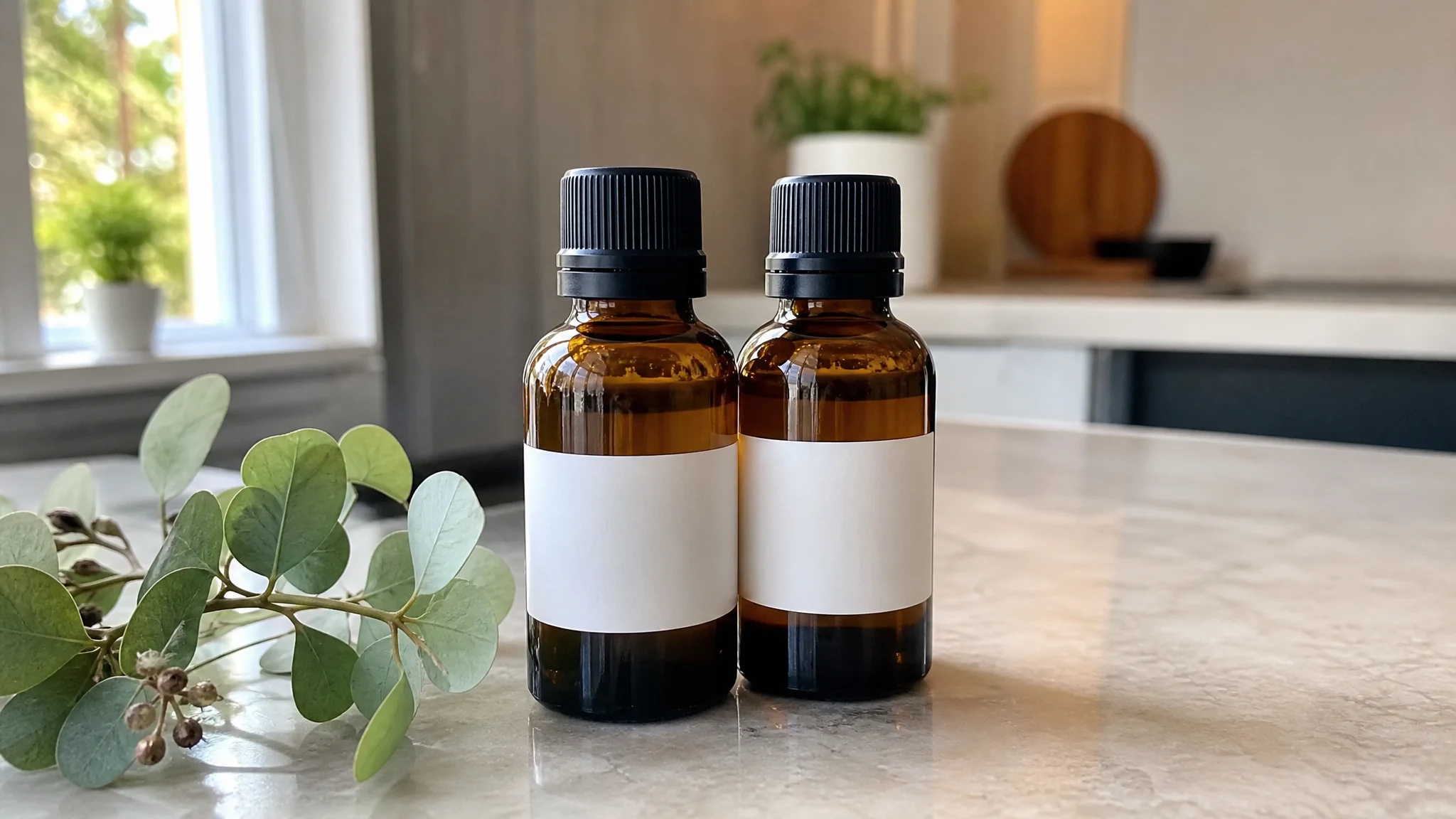
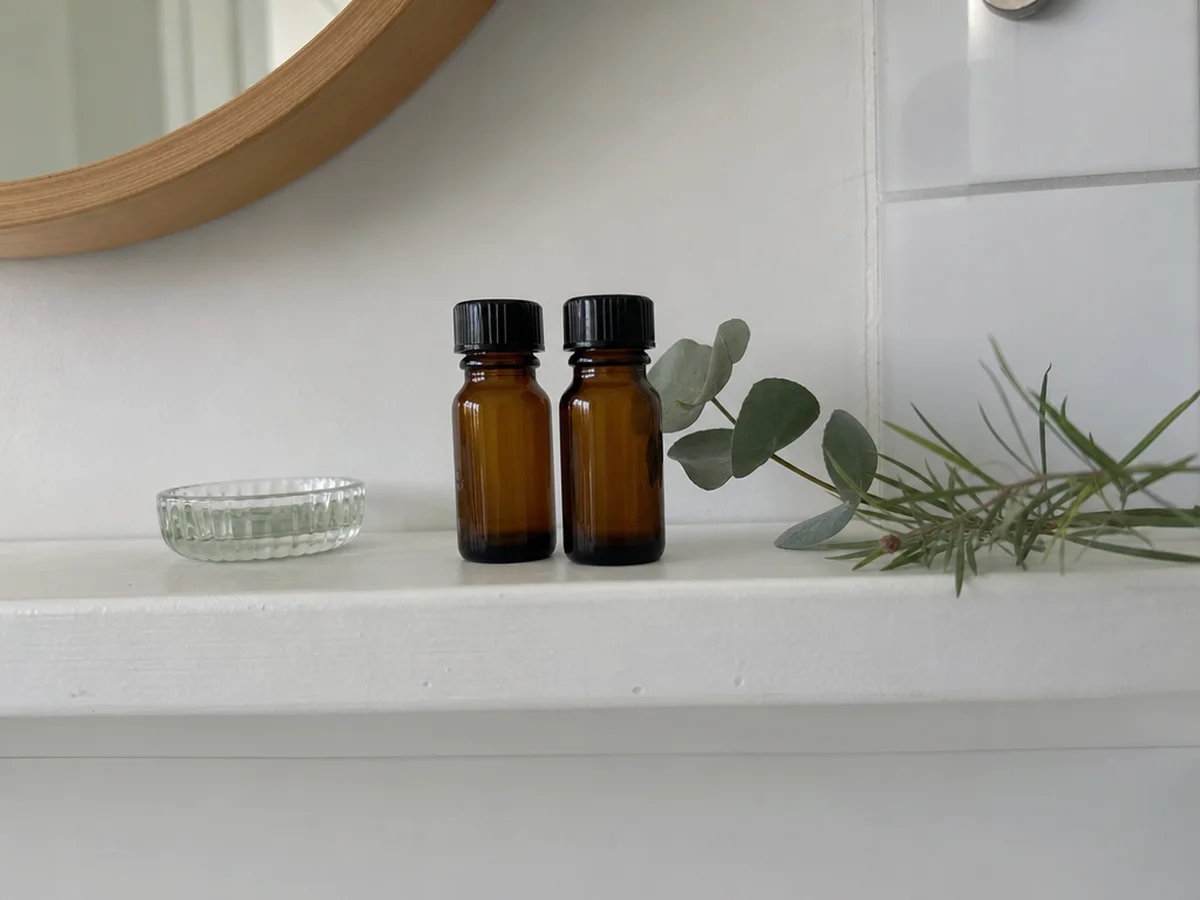
If both oils end up in your home, a little organization saves a lot of confusion. Keep them in their original labelled bottles, store them upright with caps closed, and keep them on a high shelf together in one tidy spot rather than scattered around the house. Two similar-looking amber bottles are easy to mix up in a dim bathroom, so a quick glance at the label before you pour is always worth the second.
How we would choose
- You want eucalyptus aroma. Choose by scent: camphor-fresh globulus, soft radiata or smithii, minty dives, or bright lemon eucalyptus. Our guide to sizes helps with the first bottle.
- You want tea tree. We do not sell it. Find a supplier that names the species and gives a batch report with terpinen-4-ol and cineole figures.
- You want both. Keep them in separate, labelled bottles, out of reach of children and animals. Our dilution guidance for eucalyptus is 0.5% to 2% in a carrier oil with a patch test first, and we would start at 0.5%.
- You have a health question. Your doctor, pharmacist or dermatologist is the right person, not either oil.
Two sharp leaves, then, defined by opposite compounds. Pick the one whose scent you love and whose paperwork you trust. When you are ready to order, the shop has our current sizes, the bulk page covers larger quantities, and how bulk buying works is set out in our eucalyptus essential oil bulk guide.
Eucalyptus Essential Oil
Eucalyptus Essential Oil from our own shop, in sizes from 0.5 oz to bulk.
From $9.99
Shop Now →Sources & Further Reading
- Coppen JJW and Hone GA, "Eucalyptus oils: a review of production and markets (NRI Bulletin 56)", Natural Resources Institute, 1992
- Carson CF, Hammer KA, Riley TV, "Melaleuca alternifolia (Tea Tree) Oil: a Review of Antimicrobial and Other Medicinal Properties", Clinical Microbiology Reviews, 2006
- ASPCA, "Toxic and Non-toxic Plants: Eucalyptus"